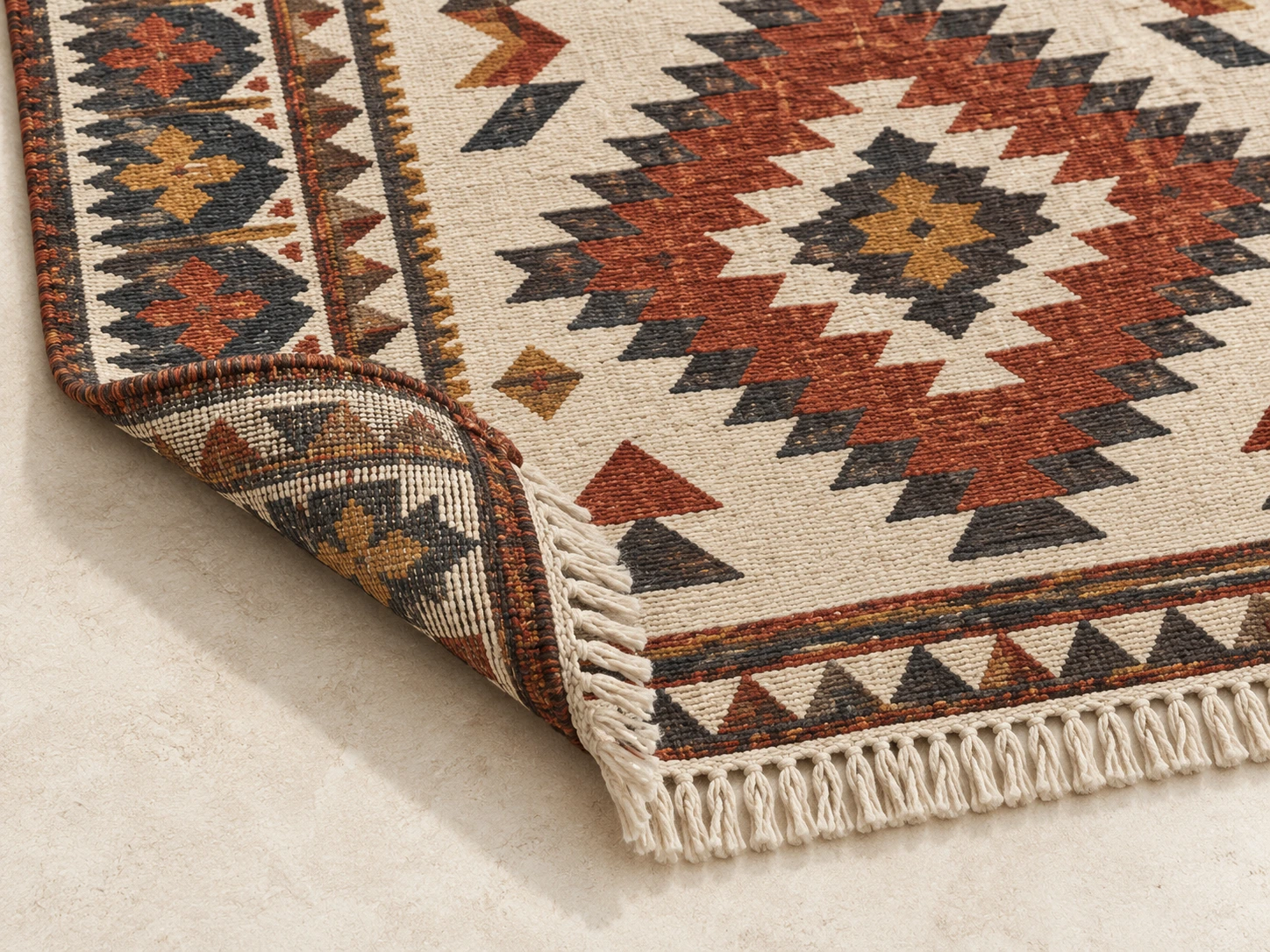
A kilim is a flatweave rug made using a slit-tapestry technique, where different coloured weft threads are woven back and forth within their own section of the pattern rather than running the full width of the rug, which is what creates the small vertical slits characteristic of kilim weaving. The tradition originates across the Middle East, the Caucasus, and Central Asia.
How to identify one
Kilims are thin, reversible, and typically feature bold geometric motifs, diamonds, or stylised tribal symbols in strong, saturated colours — a visually bolder look than the more linear stripes common in dhurries.
Why it matters to a buyer
Kilims bring a strong decorative statement at a flatweave price point, and their reversibility and light weight make them easy to ship and display. They are commonly produced in wool or wool-cotton blends.